

A helmet purchase starts with the ride you have planned. Before comparing colors, shell materials, or prices, work out what your vehicle and riding area require, how much coverage you need, and which shape fits your head.
AXEL's lineup includes several helmets with similar names. The GRIT and D.O.T. Trail Daytona models carry DOT certification; the Off Road Trail model does not. That distinction deserves a clear explanation alongside the comfort features.
I want you to be able to look at the options at Stay Ready Outdoors and understand why one might suit your use better than another. Here's how I'd work through the decision.
Start with your vehicle and riding plan
Read the protective-equipment section of your vehicle's manual and check the rules for the riding area or event. Ask about an unclear requirement before ordering. A helmet's product name or a photo of somebody wearing it in a similar vehicle doesn't settle suitability for your trip.
For a recreational off-highway vehicle such as a side-by-side, helmet selection is one part of the preparation. CPSC says "Everyone riding in an ROV should wear a helmet," along with eye protection, boots, gloves, long pants and a long-sleeved shirt. It also says to "always fasten seat belts and keep all parts of your body inside the vehicle." These measures work together. CPSC's ROV safety guidance.
Understand the DOT label
A DOT symbol on the back of a helmet means it is certified to FMVSS No. 218, the federal motorcycle helmet standard. NHTSA says it "does not approve helmets," relying instead on manufacturer self-certification. It tests some helmets and can issue a recall when one fails. Look for the full certification label and model identification. NHTSA's explanation of helmet certification.
For motorcycle riding, NHTSA's guidance is to "always wear a helmet that meets U.S. Department of Transportation (DOT) Federal Motor Vehicle Safety Standard (FMVSS) 218." An attractive finish or a familiar brand name doesn't replace that requirement. NHTSA motorcycle safety guidance.
Compare the relevant AXEL models
These prices were checked against our catalog on October 8, 2026. Check the product page for current pricing and size availability.
- D.O.T. Off Road Trail Daytona, $149. A half-shell model with a moisture-wicking fabric liner. Its listed size range runs from 3X-Small (16⅛–17 in.) to 4X-Large (25⅛–26 in.), which makes its own measurement chart especially useful when comparing it with GRIT. AXEL's Daytona specifications.
- Fiberglass GRIT D.O.T., $189. AXEL lists a fiberglass shell, twelve ventilation channels, and removable padding. Those are practical details to compare if airflow and cleaning matter to you. AXEL's fiberglass GRIT specifications.
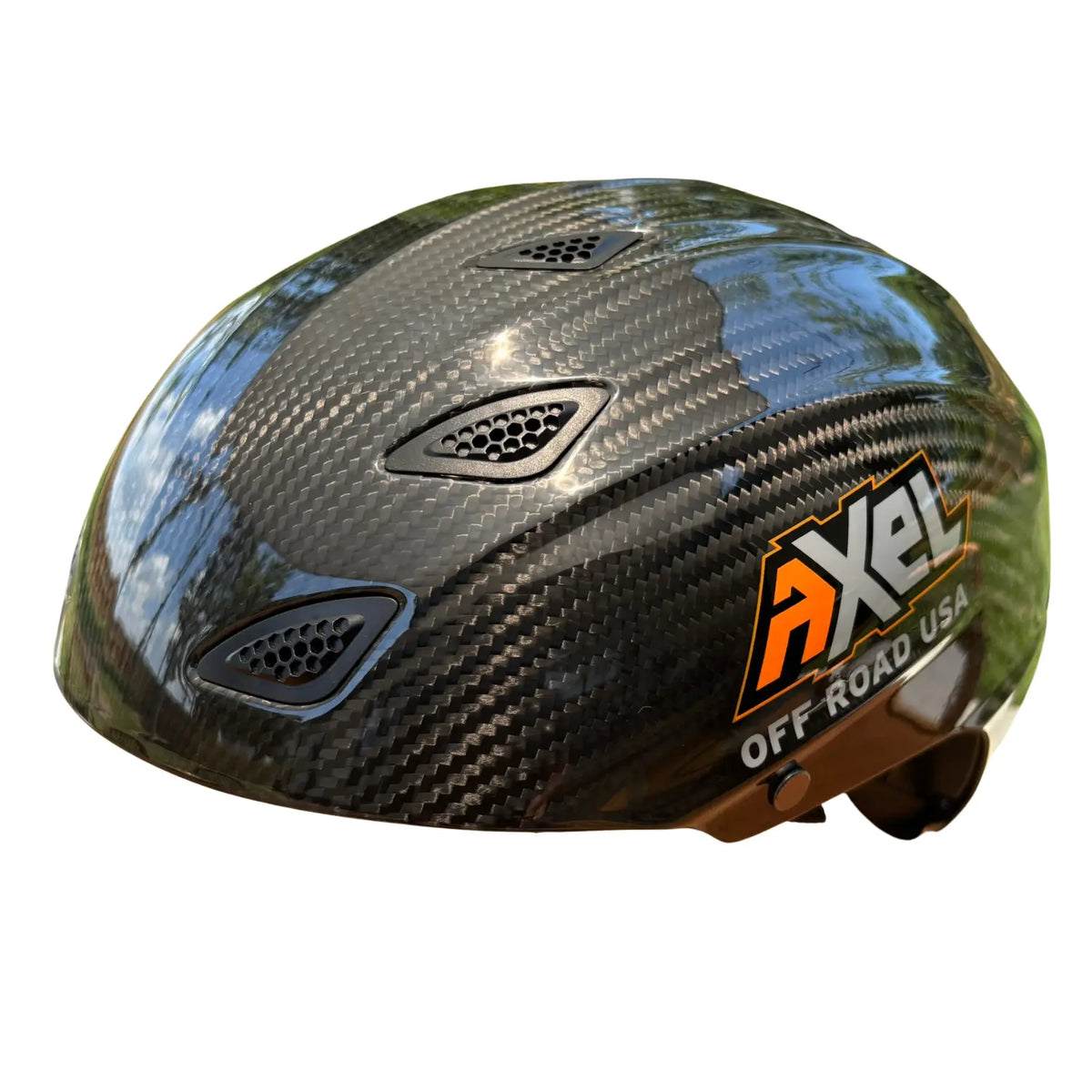
- Carbon Fiber GRIT D.O.T., $239. This version uses a carbon fiber shell with the GRIT layout, twelve ventilation channels, and removable padding. Choose it for features you value after checking use and fit. AXEL's carbon GRIT specifications.
All three are half-shell designs with an exposed face and chin. A DOT label doesn't make their coverage equivalent to a full-face design. NHTSA lists "no chin guard" as a drawback of half and open-face helmets. Consider greater coverage for your riding, and follow the requirements that apply to your vehicle and activity. NHTSA's helmet-style comparison.
Know which Trail helmet you're looking at
The $109 Off Road Trail Helmet is a separate model from the D.O.T. Trail Daytona. AXEL's own listing labels it "NOT DOT APPROVED." The manufacturer describes a high-impact ABS shell, an EVA liner, and a hand-dial sizing system; those features do not establish compliance with the motorcycle helmet standard. AXEL's Off Road Trail product information.
We don't recommend it as a substitute for a DOT-compliant motorcycle helmet or a helmet required by your vehicle, riding area, or event. A slow route doesn't resolve an equipment requirement. If you cannot verify that a helmet meets the requirements for the activity, choose a documented suitable option.
Check fit using the exact model
AXEL instructs riders to measure around the widest part of the head, roughly one inch above the eyebrows. Compare that measurement with the chart for the specific helmet. The between-size advice is opposite for these two models: for GRIT, AXEL says to choose the next size down; for the Daytona, the next size up. Don't transfer a size or sizing rule from one model to the other. The fastened helmet should be snug without painful pressure or excessive movement. GRIT fit guidance; Daytona fit guidance.
Try the helmet with the eye protection and communication equipment you intend to use. Don't drill the shell or alter the protective liner to make accessories fit. NHTSA cautions that modifying the inside of a helmet puts its integrity at risk. NHTSA's fitting advice.
Bring us the vehicle, the riding area's requirements, and your measurements if you need help comparing options. Those details are much more useful than guessing from a photograph.


