

Earthquakes don't give you a forecast you can plan a weekend around. The U.S. Geological Survey's 2015 forecast, UCERF3, put the chance of at least one magnitude 6.7 or larger earthquake in Southern California at 93% over the 30 years starting in 2014. For the Los Angeles region alone, it put that chance at 60%. USGS Fact Sheet 2015-3009.
We're based in La Mirada, so this one is close to home. This guide covers what you can set up before the shaking starts: securing what falls, strapping the water heater, knowing your gas meter, a bed kit, supplies, and alerts. It follows guidance published by the Earthquake Country Alliance, SoCalGas, USGS and the State of California. The Great ShakeOut drill is Thursday, October 15, 2026 at 10:15 a.m., which makes a good deadline. Cal OES.
When the shaking starts
The Earthquake Country Alliance (ECA) and Ready.gov give the same instruction: Drop, Cover, and Hold On.
- Drop onto your hands and knees.
- Cover your head and neck. Get under a sturdy table or desk if one is close. If not, get next to an interior wall, away from windows.
- Hold on until the shaking stops.
If you're in bed, stay there and cover your head and neck with a pillow. Don't run outside, and don't stand in a doorway. ECA's reason: "Doorways do not protect you from the most likely source of injury — falling or flying objects." ECA: Drop, Cover, and Hold On.
If you're driving, pull over, stop, and set the parking brake. Avoid overpasses, bridges and power lines, and stay in the vehicle until the shaking stops. ECA Step 5 and Ready.gov: Earthquakes.
Everything below is about making those first seconds safer and the days after easier.
1. Secure what can fall
ECA puts it plainly: "Several people died and thousands were injured in the 1994 Northridge earthquake because of unsecured items such as toppling bookcases." Its checklist for securing your space:
- Secure top-heavy furniture and appliances to wall studs.
- Secure TVs and computers with straps made for them.
- Move heavy or large items to the floor or low shelves.
- Move anything that could fall on you away from beds, couches and desks.
- Hang mirrors and pictures on closed hooks.
- Install latches on kitchen cabinets.
- Use flexible connections where gas lines meet appliances such as water heaters, ovens and dryers.
Start with the bedrooms. Those are the rooms where you can't choose where you are when it hits. ECA Step 1: Secure Your Space.
2. Strap the water heater
California law requires water heaters to be braced, anchored or strapped to resist falling during an earthquake. The state's bracing guidelines, prepared by the Division of the State Architect, cite Health and Safety Code sections 19210–19217. For tanks of 52 gallons or less, they place the upper strap about 9 inches below the top of the tank and the lower strap about 4 inches above the controls. Tanks up to 75 gallons get a third strap at mid-height. DSA water heater bracing guidelines.
Check yours this week. If the straps are missing, loose or attached to drywall instead of studs, fix them or have a licensed plumber do it.
3. Know your gas meter before you need it
This takes a few minutes and no special training. SoCalGas's guidance:
- Find the meter and shutoff valve now, in daylight, and show everyone in the house where it is.
- Stage a wrench. Keep a 12-inch or larger adjustable wrench with your emergency supplies or next to the valve. Don't store it on the meter or gas piping.
- Know when not to use it. SoCalGas: "DO NOT turn off your meter unless you smell natural gas, hear the sound of gas escaping or see other signs of a leak--and ONLY if it's safe to do so."
- Know how. Turn the valve a quarter turn in either direction, until it's crosswise to the pipe.
- Don't turn it back on yourself. SoCalGas turns the meter back on and relights pilots, after a safety inspection by SoCalGas or another qualified professional.
SoCalGas: How to shut off your natural gas.
Some homes also have an automatic earthquake shutoff valve. SoCalGas no longer installs them. They go on the house line, and they may be required by your insurer or local building department. SoCalGas on earthquake and excess flow valves. The City of Los Angeles, for example, requires a seismic or excess flow gas shutoff valve when a building with gas piping is sold. LADBS. Rules vary by city, so check with yours.
4. Build a bed kit
Shoes and a flashlight on the floor next to the bed may not be where you left them. ECA explains why: "Items that you leave next to your bed (including shoes and glasses) will be scattered during earthquakes and possibly covered with fallen items or under your bed. Shoes may also be filled with broken glass." Its recommendation is a closed bag attached to each bed. ECA Step 3: Organize Emergency Supplies.
What ECA lists for that bag:
- Sturdy shoes and socks
- Glasses or contacts
- Flashlight or headlamp
- Dust mask
- Whistle
- Work gloves
A headlamp keeps both hands free for moving debris and holding a railing. The Nitecore NU21 is an ultralight, 360-lumen rechargeable headlamp that fits in a bed bag. The Nitecore NU43 puts out up to 1,400 lumens if you want one light for the house. Add a Windstorm whistle. Ready.gov's advice if you're trapped is to "send a text, bang on a pipe or wall, or use a whistle instead of shouting so that rescuers can locate you." Ready.gov.
5. Plan for more than three days
Three days is a common minimum. Earthquake guidance written for this region asks for more:
- ECA: household supplies "to last at least 3 days and ideally for 2 weeks," with water at a "minimum one gallon a day for each person."
- Los Angeles County: "enough food, water and medications that could last for at least 10 days." ready.lacounty.gov.
At one gallon per person per day, two weeks for a household of four is 56 gallons. Store it where you can still reach it if furniture shifts or a cabinet door jams. As a backup to stored water, see our guide to water filtration, purification and treatment.
While you're organizing supplies, organize paperwork. The California Department of Insurance notes that standard homeowners, renters and condo policies don't cover earthquake damage (fire is the exception), and that if you have homeowners insurance, your insurer must offer earthquake coverage every other year. California Department of Insurance. Keep policy numbers and contacts in your family information go-folder.
6. Set up alerts and a text-first plan
Alerts. California's earthquake warning system runs on ShakeAlert, operated by the California Governor's Office of Emergency Services (Cal OES) and USGS. There are three ways to get alerts:
- MyShake app. Free, from the UC Berkeley Seismology Lab, sponsored by Cal OES. It sends warnings for magnitude 4.5 or higher. MyShake FAQ.
- Android phones. Earthquake warnings are built into millions of Android phones in California, with no app needed.
- Wireless Emergency Alerts. These go out for magnitude 5.0 or higher, at no cost. Cal OES fact sheet.
Earthquake Warning California. There's no app to download for Wireless Emergency Alerts, but check that emergency alerts are turned on in your phone's settings. Depending on the phone, the setting is under Emergency Alerts or Government Alerts. USGS: Be ShakeAlert Safe.
Know the limit: if you're close to the epicenter, strong shaking can arrive before the alert does. USGS calls this the "blind zone." USGS. An alert is a head start when you get one, not a guarantee.
Text first. After a large earthquake, everyone calls at once. The FCC's advice: "In many cases text messages will go through when your call may not." Keep calls brief, and wait 10 seconds before redialing. FCC: Tips for communicating in an emergency. Pick an out-of-area contact everyone in the family texts, and write the number down. Our communications redundancy plan covers what to add when the network is down entirely.
Practice on October 15
At 10:15 a.m. on October 15, drop, cover, and hold on wherever you are. Then use the drill to check your setup:
- Find the wrench and walk to the gas meter.
- Open a bed kit and try on the shoes.
- Have everyone text the out-of-area contact.
Schools, businesses and families can register their drill at shakeout.org/california.
Setting up a bed kit or restocking supplies and not sure what fits where? Tell us what you have, and we'll help you fill the gaps.
Related Field Manual guides
- Why the First 72 Hours Matter in Survival
- Build a Family Information Go-Folder Before You Need It
- A Practical Communications Redundancy Plan for Home, Trail, and Convoy
- Does Your Trauma Kit Expire? Storage, Heat, and When to Replace It
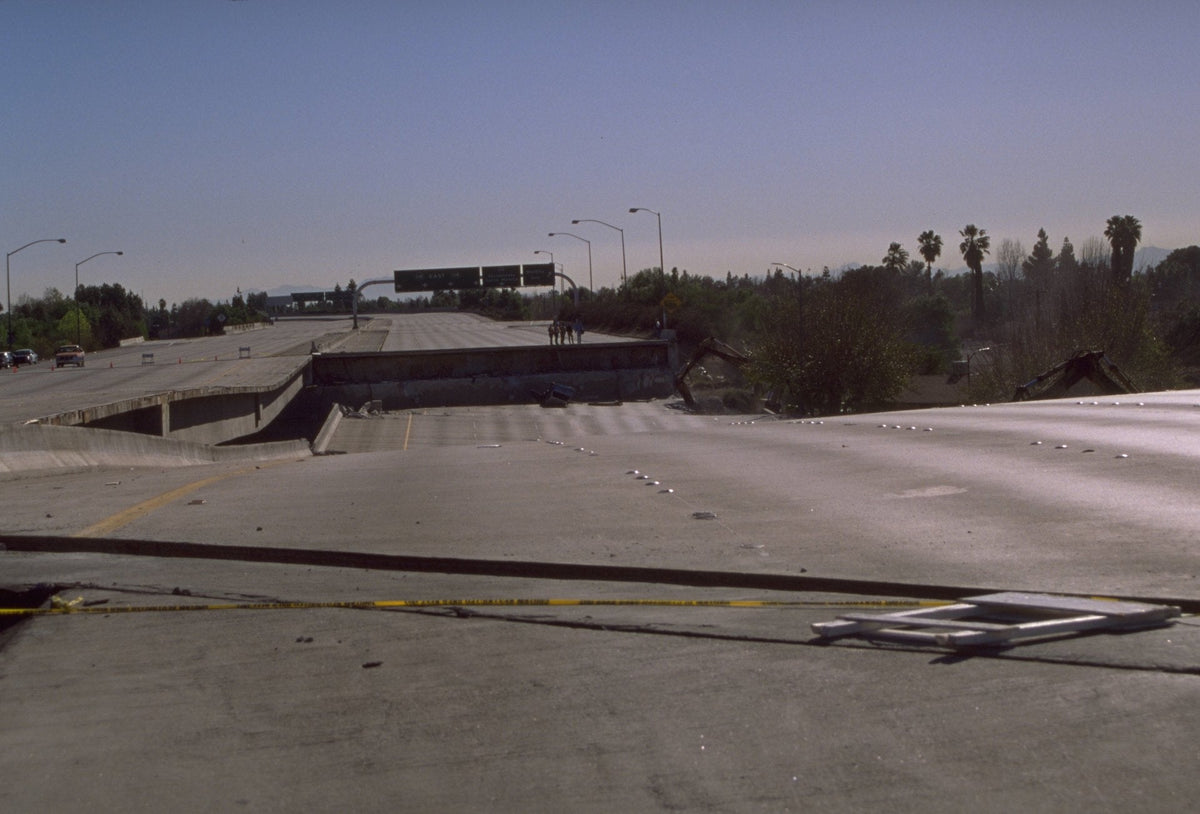
Featured image: a collapsed section of freeway after the 1994 Northridge earthquake. Photo: U.S. Geological Survey, public domain.


