

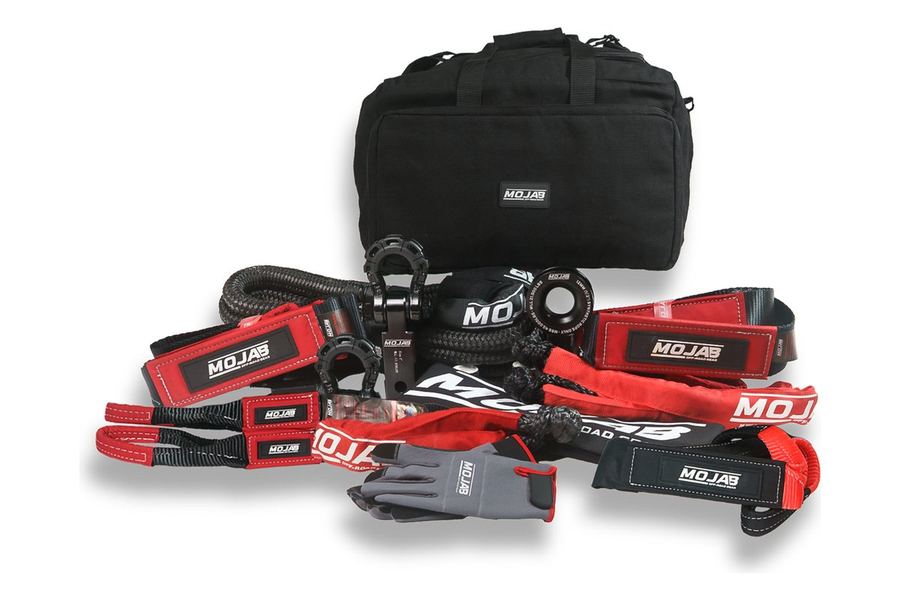
A recovery bag is easy to buy. Figuring out which equipment belongs in it takes more thought. A useful setup starts with the vehicle you drive, its approved attachment points, the terrain you expect, and the training you have.
At Stay Ready Outdoors, I want customers to understand those decisions before choosing a kit. This guide covers equipment selection and preparation. Recovery technique needs hands-on instruction and the directions for the specific equipment involved.
Start with the vehicle manual
Before comparing ropes, read your vehicle's towing and recovery instructions. Identify the permitted attachment points and the operations the manufacturer allows. A threaded eye behind a bumper cover doesn't, by itself, tell you whether that point is suitable for freeing a bogged vehicle.
For example, Tesla's Model 3 instructions describe using its tow eye to pull the vehicle slowly onto a flatbed. That is a specific transport procedure. Don't turn it into permission for a different recovery method. The instructions for your exact vehicle take priority. Tesla's transport instructions.
Never use a trailer hitch ball as a recovery attachment point. Australia's consumer safety regulator, the ACCC, warns that the force of a recovery strap "is likely to break or snap off normal attachment points such as tie-down eyes, tow balls, towbars," and says to use one only "with proper robust recovery points." A large number on a rope label cannot make an unsuitable vehicle attachment safe. ACCC recovery strap guidance.
Understand the job each piece does
Towing, kinetic recovery, and winching put different demands on equipment. Don't assume that two products with similar names are interchangeable. A snatch strap or kinetic rope is designed to stretch. Other straps have narrower jobs: ARB describes a tree trunk protector as "designed primarily to protect a tree from girdling," and a winch extension strap as "used for the sole purpose of extending the reach of a winch line." Follow the stated use for each component. ARB's recovery equipment overview.
A kit also doesn't receive one universal capacity because its parts arrive in the same bag. Check the instructions and ratings for the rope, straps, connections, attachment points, and any other equipment used together. If compatibility isn't clear, get an answer before using it.
Breaking strength and working load are different numbers
Minimum breaking strength, or MBS, describes a minimum failure threshold under the relevant test conditions. It is not a recommended operating load. Working load limit, or WLL, is the manufacturer's stated operating limit under specified conditions. Don't convert between them using an assumed safety factor, or interpret either number as a universal vehicle-weight allowance. Dawnerz's explanation of shackle ratings.
As one concrete example, MOJAB lists its 1/2-inch soft shackle with a 46,000-pound MBS and a separate 15,400-pound WLL. Those are different specifications for that component. They are not a rating for an assembled recovery system. MOJAB's published specifications.
Soft and steel shackles both have limitations
Soft shackles are lightweight and easy to pack. WARN notes that they "are more prone to damage by abrasion" and "shouldn't be attached to rigging points with sharp edges." A protective sleeve doesn't make every attachment surface suitable. Steel shackles carry their own working load limits, and WARN's instruction for the pin is to screw it down hand-tight, then back it off a quarter turn to prevent binding. Choose the connection the application calls for. WARN's comparison of soft and metal shackles.
Synthetic connections don't remove the energy stored in a loaded strap or rope. The ACCC says bystanders "should never stand in the path of either vehicle," and recommends draping a recovery damper, heavy bag or blanket over the strap during use to reduce rebound. Keep people out of the recovery area and follow the equipment's clearance instructions. ACCC safety guidance.
Where the MOJAB options fit
These are starting points for comparison, subject to the vehicle and equipment checks above:
- Individual soft shackles: Useful when suitable connections are the missing part of an existing setup.
- UTV/ATV Essential: A compact kit with a 5/8-inch by 26-foot kinetic rope, two 1/4-inch soft shackles, and gloves.
- Supreme: Built around a 4-inch by 30-foot flat tow strap, with two soft shackles, two steel D-shackles, a 2-inch hitch receiver, and gloves. It does not include a kinetic rope.
- Heavy-Duty: A broader selection with a 7/8-inch by 30-foot kinetic rope, four straps including a tree saver, soft and steel shackles, and a 3.8-inch snatch ring.
These descriptions follow MOJAB's current UTV/ATV, Supreme, and Heavy-Duty contents lists. Compare the available options in our recovery collection.
Know when to call a professional
My recommendation: stop when the situation exceeds your training or you cannot verify the equipment and attachment points. Traffic, unstable ground, a vehicle at risk of rolling, or damage affecting how it can be moved are reasons to involve a qualified recovery operator. If people are in immediate danger, contact emergency services.
Before a trip, inspect the equipment, keep its instructions accessible, and arrange reputable hands-on training. Among the ACCC's checks: make sure the strap "is not damaged or worn before use." That preparation matters more than buying the largest kit. ACCC's inspection and training guidance.
Questions about narrowing the options? Tell us what you drive and where you take it. We'll help you identify what needs checking before you buy.


