

Issue date: October 5, 2026
Reporting window: September 29–October 5, 2026
Sources reviewed: October 5, 2026
A preparedness check does not always begin with a siren. Sometimes it begins with a flowerpot saucer, a folded tarp, a child’s toy, or a bucket that held rain for a few days.
Hillsborough County, Florida, extended its local state of emergency for dengue through October 8 and announced expanded daytime mosquito treatment for several communities. At the same time, the National Weather Service kept flood watches in parts of northern Florida and southeast Georgia on October 5. Those are local conditions—not a national dengue warning—but they point to a useful household task anywhere mosquitoes remain active: remove the small water sources that let the next generation hatch.
Follow your local health department, mosquito-control district, and National Weather Service office for instructions that apply to your location. If professional treatment is planned in your area, use the agency’s published schedule and contact information rather than social-media summaries.
The current signal
On October 1, Hillsborough County extended its dengue-related emergency declaration. On October 4, the county said low-flying helicopters would conduct daytime mosquito treatment during the week in East Tampa, East Lake, Palm River, and Bloomingdale. County updates said mosquito traps continued to show dengue virus activity and that the program was coordinating surveillance, education, and treatment with the Florida Department of Health.
Separately, the National Weather Service’s Jacksonville office extended a flood watch across parts of northern Florida and southeast Georgia early October 5. Heavy rain creates immediate travel and flood hazards, but it can also refill the ordinary containers around a home where mosquitoes lay eggs. That second-order problem is smaller and quieter—and much easier to address early.
A ten-minute standing-water check
1. Walk the small perimeter
Start within a few steps of the house, garage, shed, patio, or campsite. Look inside buckets, plant saucers, toys, tarps, tires, wheelbarrows, watering cans, pet dishes, birdbaths, trash lids, clogged gutters, and low spots in outdoor equipment. A large pond is obvious; the practical misses are usually the small containers.
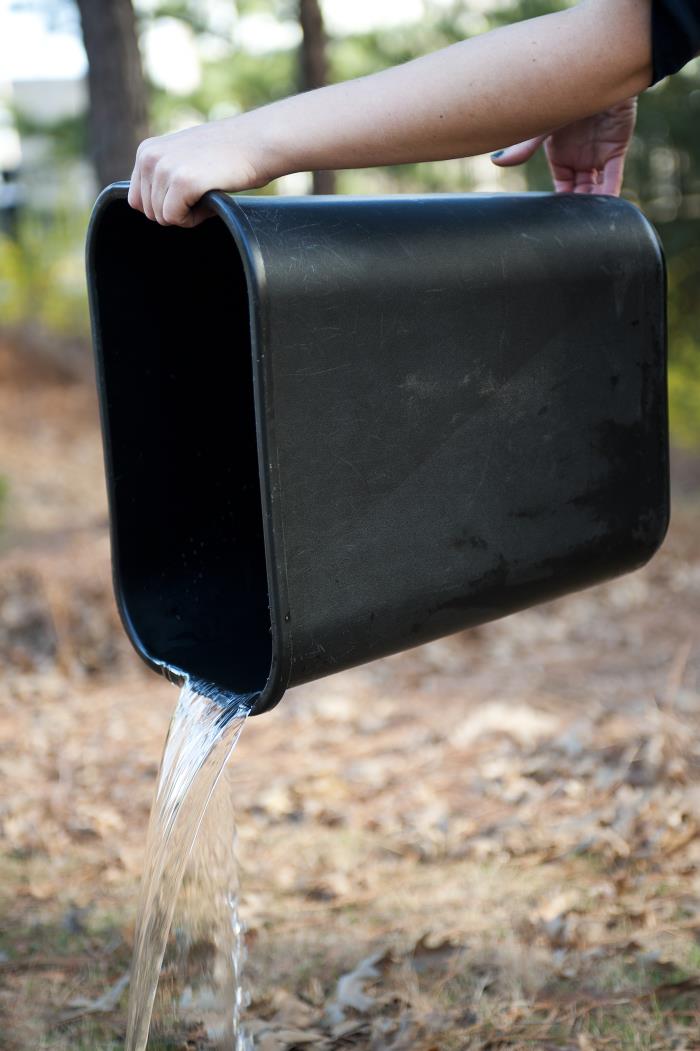
Once a week, empty and scrub, turn over, tightly cover, or discard items that hold water. Scrubbing matters because mosquito eggs can adhere to the inside of a container. Do not simply top off or add fresh water to an old container.
2. Protect water that must remain stored
Tightly cover rain barrels, cisterns, and utility water containers. For an opening without a lid, CDC guidance recommends mesh with holes smaller than an adult mosquito. Do not add a pesticide or larvicide to drinking water unless the product label explicitly allows that use and local public-health guidance supports it.
Water set aside for drinking should remain separate from water used for cleanup, irrigation, or mosquito-control treatment. A portable filter is not a substitute for following the label on a pesticide or for local drinking-water guidance.
3. Check the house boundary
Repair torn window and door screens, close gaps, and avoid leaving doors—including garage doors—propped open. Check indoor vases and plant saucers, too. Mosquitoes that enter a house can rest in dark, humid places and may lay eggs in small indoor water sources.
4. Audit bite protection before the next evening outside
Check the repellent you already own. Look for an EPA registration number, confirm that mosquitoes are included on the label, make sure the container is intact and the directions are legible, and choose a protection time that fits the actual activity. Apply and reapply only as the label directs. More product is not automatically better.
Pair repellent with practical barriers: long sleeves and pants when conditions allow, intact screens, and fewer open doors. Store repellents where children cannot reach them. For children, pregnancy, skin sensitivities, or other health questions, use the product label and ask a healthcare professional when needed.
5. Know what should trigger medical care
The most common dengue symptom is fever together with symptoms such as headache or pain behind the eyes, muscle or joint pain, nausea, vomiting, or rash. CDC advises people with symptoms who live in or recently traveled to an area with dengue risk to contact a healthcare provider.
Severe dengue is a medical emergency. Seek immediate care for warning signs such as belly pain or tenderness, repeated vomiting, bleeding from the nose or gums, blood in vomit or stool, or extreme tiredness or restlessness—especially as a fever is going away.
If local mosquito treatment is scheduled
- Confirm the location and time on the official county, city, or mosquito-control page.
- Give crews and low-flying treatment aircraft room to work.
- Follow any location-specific instructions for people, pets, outdoor food, pools, or beehives.
- Use the agency’s contact line for health or pesticide questions rather than guessing from a photo or short post.
Check what you already own
The first equipment check is simple: an EPA-registered repellent appropriate for the people and activity, intact screens, and a way to cover stored water. Those items solve different parts of the problem; no single product replaces the others.
If your audit shows that you specifically need a concentrated DEET option for severe insect conditions, Stay Ready Outdoors carries Sawyer MAXI DEET 4 oz spray. The active product page lists 98.11% DEET and a price of $10.99 as of October 5, 2026. Read the complete label before purchase and use, and match the concentration and protection time to the person and activity. Reply with who will use it, the expected exposure time, and the setting if you want help deciding whether this is the right format—or whether a different registered repellent would be more appropriate.
Related SRO Field Manual guides
- A Practical Communications Redundancy Plan for Home, Trail, and Convoy
- Does Your Trauma Kit Expire? Storage, Heat, and When to Replace It
Direct sources
- Hillsborough County: Emergency Orders — dengue emergency extension posted October 1, 2026
- Hillsborough County: Mosquito Operations — treatment update October 4, 2026
- National Weather Service: Flood Watch summary — issued October 5, 2026; reviewed October 5, 2026
- CDC: Mosquito Control at Home — April 16, 2024; reviewed October 5, 2026
- CDC: Preventing Dengue — reviewed October 5, 2026
- CDC: Symptoms of Dengue and Testing — updated August 7, 2025; reviewed October 5, 2026
- EPA: Find the Repellent That Is Right for You — reviewed October 5, 2026
Featured photo: Lauren Bishop, CDC/National Center for Emerging and Zoonotic Infectious Diseases, 2016. Public-domain U.S. government image; cropped for presentation. Source and rights. Use of this image does not imply CDC or U.S. government endorsement.
Stay Sharp. Stay Ready.


